
Short answer: on an agarose gel, intact eukaryotic total RNA shows two sharp ribosomal RNA bands — 28S on top and 18S below — with the 28S band roughly twice as intense as the 18S band (a 28S:18S ratio of about 2:1). A ratio near 1:1, a fainter 28S band, or a smear toward the bottom of the lane points to degradation. Below is a real gel from our lab showing what the “good” pattern looks like, lane after lane.
A real intact-RNA gel: total RNA from shrimp muscle
The gel below was run with total RNA isolated from shrimp muscle tissue using the CYRN28 Plus RNA Mini Kit (Cells or Tissues). The image is shown unedited.
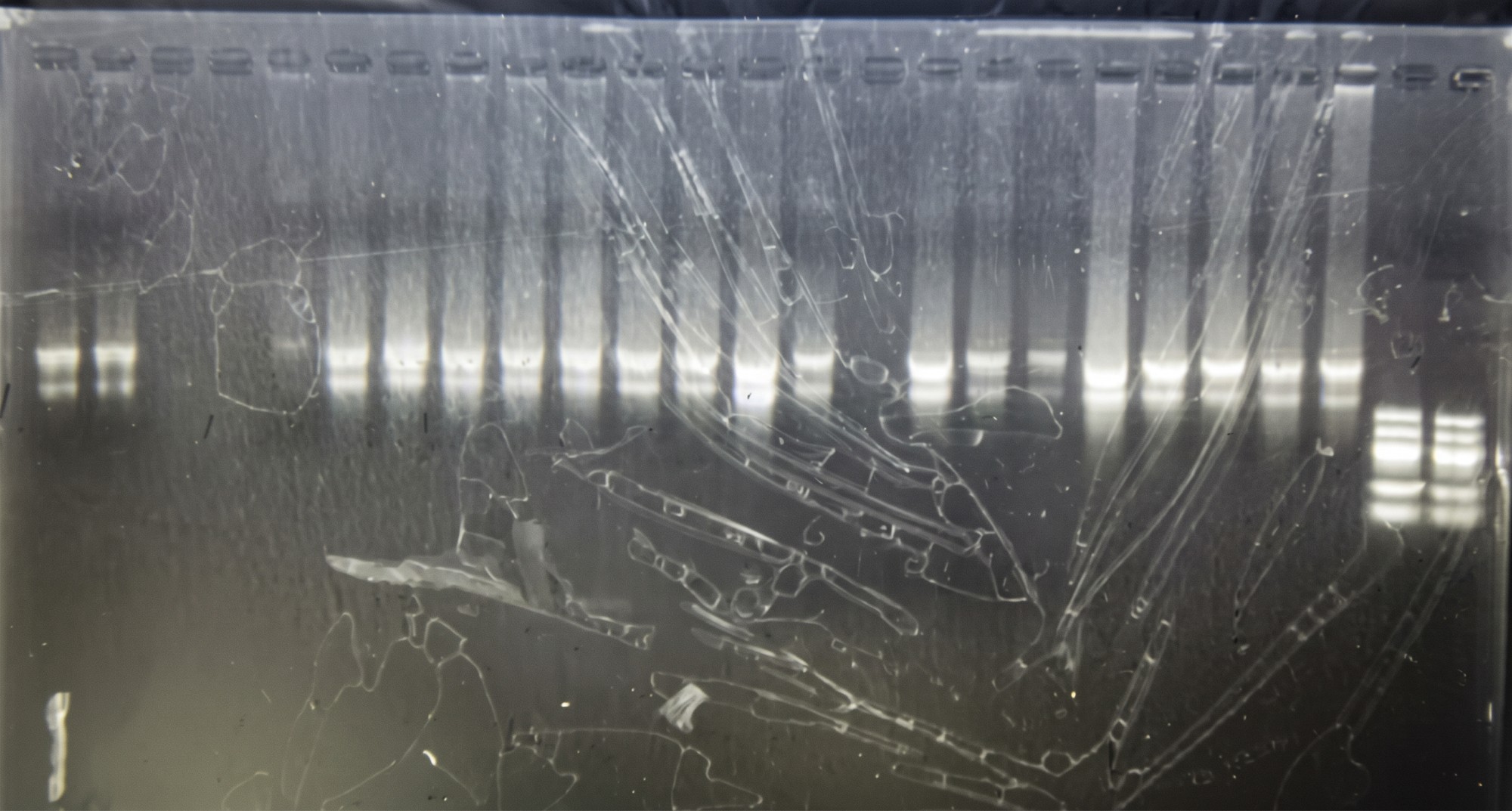
How to read it:
- Two distinct bands in every loaded lane. The upper band is 28S rRNA, the lower band is 18S rRNA. They are separated cleanly, not merged into one blur.
- The 28S band is the stronger band. It is thicker and brighter than the 18S band — the classic intact pattern. When RNA degrades, 28S is lost first and this relationship flips.
- No smear below the 18S band. The lane below the rRNA doublet is clean. Degraded RNA leaves a downward smear of fragments (compare our degraded RNA gel example).
- Consistent across replicates. The pattern repeats across more than 15 samples, which tells you the extraction itself is reproducible, not just one lucky prep.
A note on reading ratios from photos: the bands in this image are bright enough to approach camera saturation, which is normal for a quick QC gel but means the exact 28S:18S number cannot be calculated from the picture. For a numeric ratio, image a less-loaded gel at an unsaturated exposure, or use a capillary system (Bioanalyzer/TapeStation) that reports both the ratio and a RIN.
What is the 28S:18S ratio — and why 2:1?
About 80% of total RNA mass in a eukaryotic cell is ribosomal RNA. The large ribosomal subunit carries the 28S rRNA; the small subunit carries the 18S rRNA. Both are made in equal numbers of copies, but 28S is a much longer molecule, so it carries more nucleotides and binds more fluorescent dye. That is where the expected intensity ratio of roughly 2:1 (28S:18S) comes from.
Because 28S is longer and contains more sites susceptible to RNase cleavage, it breaks down faster than 18S. A falling 28S:18S ratio is therefore one of the earliest visible signs of RNA degradation.
28S and 18S rRNA sizes
| RNA species | Approx. size (human/mammalian) | Where it runs on the gel |
|---|---|---|
| 28S rRNA | ~5,000 nt (≈5.0 kb) | Upper, brighter band |
| 18S rRNA | ~1,900 nt (≈1.9 kb) | Lower band |
| 5.8S / 5S rRNA, tRNA | ~70–160 nt | Faint, fast-running band near the bottom |
Sizes differ between organisms: the large-subunit rRNA is shorter in many invertebrates, plants and fungi than in mammals. On a non-denaturing (native) gel, apparent sizes against a DNA ladder are also not exact, because RNA secondary structure changes how it migrates. Read the gel by pattern — two sharp bands, top one stronger, clean lane — rather than by absolute size.
How to interpret 28S:18S band patterns
| What you see | What it means | Next step |
|---|---|---|
| Two sharp bands, 28S clearly stronger (≈2:1) | Intact RNA | Proceed to RT-qPCR, RNA-seq or cloning |
| Two bands of similar intensity (≈1:1) | Partial degradation (in mammalian/cell RNA) | Fine for short-amplicon qPCR; risky for RNA-seq |
| 18S stronger than 28S, smear below | Significant degradation | Re-extract; review sample stabilization |
| Only a smear, no bands | Severely degraded RNA | Discard and re-isolate |
| Extra bright band near the well | Genomic DNA carry-over | DNase treatment; include a no-RT control |
| “One band” where 28S and 18S should be | Bands not resolved, or 28S has collapsed (see invertebrate note below) | Run longer / adjust agarose %; check organism |
Special case: invertebrate and insect RNA
In many protostome invertebrates — insects are the best-known example — the 28S rRNA carries a so-called “hidden break”. Under denaturing conditions (heat, formamide or formaldehyde) the 28S molecule separates into two halves that run at or near the 18S position, so intact RNA can look like a single band and be mistaken for degraded RNA. If you work with arthropods, molluscs or other invertebrates and see only “one band”, check your gel conditions before discarding the sample, and do not apply the mammalian 2:1 rule mechanically. In the shrimp gel above, a standard quick-check agarose gel shows both bands clearly.
Gel vs. A260/A280 vs. RIN
- A260/A280 tells you about protein contamination, not integrity. A perfect 2.0 can come from completely degraded RNA. See our A260/A280 ratio guide.
- Agarose gel (28S/18S) is the fastest, cheapest integrity check and works in any lab with an electrophoresis tank.
- RIN (RNA Integrity Number) from capillary electrophoresis gives a 1–10 score using the whole electropherogram, not just the two rRNA peaks — recommended before RNA-seq.
For a full workflow combining both checks, read How to Check RNA Quality.
Quick protocol: an RNA integrity check gel
- Prepare a 1–1.2% agarose gel in fresh, RNase-free TAE or TBE buffer; use a clean comb and tank.
- Load about 0.5–1 µg total RNA per lane with RNA-compatible loading dye. Overloading blurs the bands and hides ratio differences.
- Run at roughly 5 V/cm until the dye front has migrated about two-thirds of the gel.
- Image with an exposure that keeps the 28S band below saturation if you want to estimate the ratio.
- Read the pattern: two sharp bands, 28S stronger, no smear, no gDNA band near the well.
Getting this result from tissue samples
Muscle and other tissues are rich in RNases, and integrity is mostly decided in the first minutes after sampling. Two practical rules:
- Stabilize at the point of collection. If tissue cannot be processed or snap-frozen immediately, place it in an RNA stabilization reagent such as CYRN15 RNAfixer.
- Use a column kit that removes gDNA and inhibitors. The CYRN28 Plus RNA Mini Kit used for this gel is designed for cells and animal tissues.
Frequently asked questions
Q: What is a good 28S:18S ratio?
About 2:1 for intact mammalian or cultured-cell total RNA. Ratios of 1.8–2.0 or higher with sharp bands indicate good integrity; values near 1:1 suggest degradation. Many invertebrates and plants deviate from this rule.
Q: Why do I see two bands on my RNA gel?
Those are the 28S (upper) and 18S (lower) ribosomal RNAs, which make up most of total RNA. Two sharp bands are what you want to see.
Q: Why is my 18S band brighter than my 28S band?
Most often because the RNA is partially degraded — 28S is cleaved first. In invertebrates, it can also be the hidden break in 28S rRNA.
Q: Can I use a non-denaturing agarose gel to check RNA integrity?
Yes, for a quick check. A clean native gel with fresh buffer resolves 28S and 18S well enough for a go/no-go decision. Denaturing gels or capillary electrophoresis are better when you need precise sizing or a RIN.
Q: Is a gel enough before RNA-seq?
A gel is a good first filter. Most sequencing providers additionally require a RIN (commonly ≥7) from capillary electrophoresis.
References
- Schroeder A, et al. The RIN: an RNA integrity number for assigning integrity values to RNA measurements. BMC Molecular Biology. 2006;7:3. doi:10.1186/1471-2199-7-3
- Imbeaud S, et al. Towards standardization of RNA quality assessment using user-independent classifiers of microcapillary electrophoresis traces. Nucleic Acids Research. 2005;33(6):e56. doi:10.1093/nar/gni054
- Winnebeck EC, Millar CD, Warman GR. Why does insect RNA look degraded? Journal of Insect Science. 2010;10:159. doi:10.1673/031.010.14119
Related reading: RNA agarose gel electrophoresis · Running mRNA on an agarose gel · What degraded RNA looks like on a gel
All products mentioned are for research use only (RUO). Not for diagnostic, therapeutic, or clinical use.
All RNA purity and integrity numbers in one table, with primary sources: RNA quality reference values.
Related gel and RNA quality guides
- What degraded RNA looks like on a gel
- Reading RNA integrity on agarose gel
- mRNA on agarose gel: smears and bands
- How to run RNA on a standard agarose gel
- RNA gel troubleshooting: extra bands, smears and odd sizes
- Genomic DNA quality on agarose gel
- A260/A280 for RNA: the complete guide
Related products: RNApure Total RNA Kit (CYRN03) | Plus RNA Mini Kit (CYRN28) | RNAfixer RNA Stabilization Solution | All RNA & DNA extraction kits | Request a quote