
CYRN15 RNAfixer is an aqueous RNA stabilizer for fresh animal tissues, cultured cells, and some plant tissues. Immerse the sample immediately — do not freeze it first. In solution, RNA is typically held about 1 day at 37°C, 1 week at 25°C, or 1 month at 4°C. The reagent ships without ice packs. Research Use Only.
Stability at a glance
| Sample | Storage | Stability |
|---|---|---|
| Fresh tissue | 37°C | Up to 1 day |
| Fresh tissue | 25°C (ambient) | Up to 1 week |
| Fresh tissue | 4°C | Up to 1 month |
| Fresh tissue | −20°C / −80°C | Long-term (overnight at 4°C first) |
| RNA viruses (HCV, HIV) | 37°C | Up to 1 month |
| Bacteria (E. coli) | 4°C | Up to 1 month |
| Yeast | 25°C / 4°C | 8 h / 1 week (freeze for longer) |
Sample preservation does not require liquid nitrogen, dry ice, or −80°C freezers. Cut fresh tissue so one side is under 0.5 cm; small organs such as mouse liver, kidney, or spleen can go in whole. Use about 5 volumes of reagent for tissue, 5–10 volumes for cultured cells, or 3 volumes for whole blood. All values are from the CYRN15 manual.
Available product families
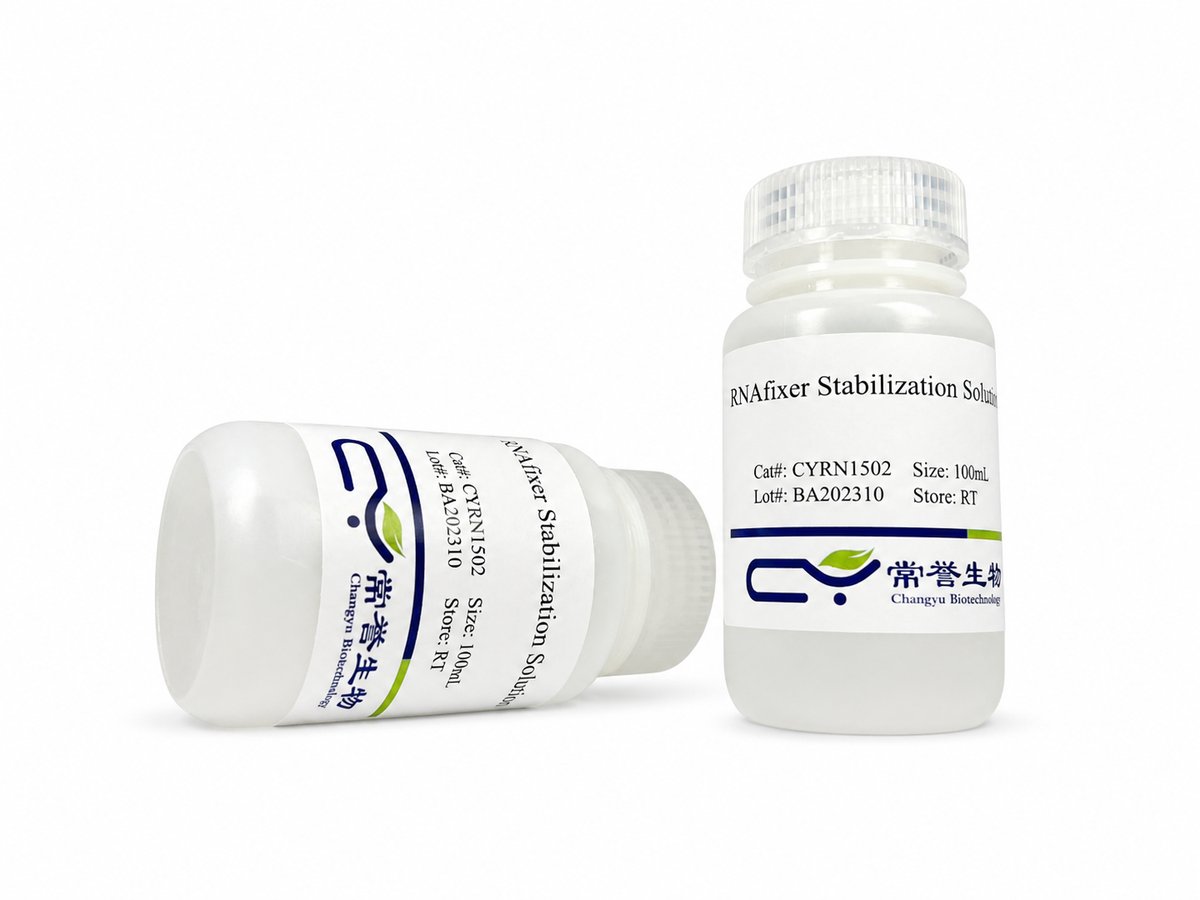
RNAfixer Stabilization Solution
Cat# CYRN15 — Room-temperature RNA stabilizer for fresh tissue (do not freeze first); about 1 week at 25°C in solution. Research Use Only.
Typical research applications
- Collecting fresh animal tissue without liquid nitrogen
- Stabilizing cultured cells, and some plant tissues, before RNA extraction
- Holding samples about 1 week at 25°C for ambient shipment
- Longer hold at 4°C (about 1 month) or at −20°C / −80°C after immersion
Handling that actually matters
- Fresh tissue only — immerse immediately after collection. Do not freeze the sample first.
- Times in solution (from the manual) — about 1 day at 37°C, 1 week at 25°C, 1 month at 4°C; longer at −20°C or −80°C.
- The reagent itself — store the liquid at 18–25°C for 12 months. If it separates, warm at 37°C to redissolve. Ships ambient (no ice packs).
- Downstream — RNAfixer-treated samples are used with Changyu Plus RNA Mini kits (CYRN28) and other silica-column RNA protocols. Research Use Only.
RNAfixer vs. RNAlater vs. RNAprotect
| RNAfixer (CYRN15) | RNAlater (Thermo Fisher) | RNAprotect Tissue (QIAGEN) | |
|---|---|---|---|
| Purpose | Fresh-tissue RNA stabilization | Fresh-tissue RNA stabilization | Fresh-tissue RNA stabilization |
| Liquid nitrogen required? | No — no LN2, dry ice, or −80°C freezers | No | No |
| Tissue piece size | One side < 0.5 cm | ≤ 0.5 cm | ≤ 0.5 cm |
| Reagent volume | 5 vol tissue · 5–10 vol cells · 3 vol blood | ≥ 5 vol (per manual) | per handbook |
| Hold at 25°C | Up to 1 week | Up to 1 week | Up to 7 days |
| Hold at 4°C | Up to 1 month | Up to 1 month | Up to 4 weeks |
| Reagent shelf life | 12 months at 18–25°C | per label | per handbook |
| Disposal | Aqueous, non-toxic — drain disposal per manual | — | — |
| Pack sizes | CYRN1501 50 ml · CYRN1502 100 ml | various | various |
Competitor details are from each manufacturer’s public documentation and may change — confirm the current manual before writing SOPs. RNAfixer details are from the CYRN15 manual (PDF).
For a fuller walk-through, read RNAfixer vs RNAlater: RNA Stabilization Reagents Compared.
Frequently asked questions
- How long does RNAfixer preserve samples? In solution: about 1 day at 37°C, 1 week at 25°C, 1 month at 4°C. Do not use a generic “48 hours at room temperature” figure — that is not this product’s manual.
- Can I freeze the tissue first? No. Cut to size and immerse fresh. After immersion, samples may be frozen.
- What sizes exist? CYRN1501 50 ml and CYRN1502 100 ml. Request a quote; there is no list price on this site.
- Is this for diagnostic specimens? No. Research Use Only (RUO). Not for diagnostic, therapeutic, or clinical use.
- Why is it sometimes written “RNAfix”? RNAfix and RNAfixer refer to the same reagent — “rnafix” is the common short form used in lab protocols. The full product name is RNAfixer (CYRN15).
- Do I need liquid nitrogen or dry ice? No. Sample preservation does not require liquid nitrogen, dry ice, or −80°C freezers. Immerse fresh tissue at collection; freeze (−20°C / −80°C) only after overnight incubation at 4°C.
- How should I cut tissue, and how much reagent do I need? Cut fresh tissue so one side is under 0.5 cm; small organs such as mouse liver, kidney, or spleen can go in whole. Use about 5 volumes of RNAfixer for tissue, 5–10 volumes for cultured cells, or 3 volumes for whole blood. Blot excess reagent from tissue before extraction.
- Is RNAfixer validated for RNA-seq? The CYRN15 manual does not make an RNA-seq claim. It states the reagent reduces errors in large-scale sample processing and increases comparability between experiments — especially useful for large-scale gene expression profiles. For expression-level studies, run a matched pilot against snap-frozen controls before adopting a preservation workflow.
- How is RNAfixer disposed of? RNAfixer is aqueous and non-toxic. Per the manual, used solution can be disposed of down the drain with tap-water rinsing.
Request a quotation · Email market@changyubio.com · WhatsApp +86 18665577773
All products are for Research Use Only (RUO). Not for diagnostic, therapeutic, or clinical use.