
A spectrophotometer can tell you that your RNA sample absorbs at 260 nm. It cannot tell you whether that absorbance comes from intact RNA, from degraded fragments, or from genomic DNA carried over during extraction. This is why, in any RNA workflow that matters — RT-qPCR, RNA-seq, cloning, probe preparation — a quick agarose gel should come before every downstream experiment.
The blind spot of OD ratios
A260/A280 and A260/A230 ratios are widely used as purity checks, and for good reason: they are fast, need tiny amounts of sample, and catch gross protein or chaotropic-salt contamination. What they cannot do is confirm integrity.
Three common situations produce a “perfect” 1.8–2.0 ratio with RNA that is anything but perfect:
- Partial degradation. Degraded RNA still absorbs at 260 nm. In fact, the absorbance of fragmented nucleic acid can run higher than the same mass of intact polymer (hyperchromicity), so a degraded sample can report a higher concentration than it actually contains.
- Genomic DNA carryover. DNA absorbs at 260 nm just as RNA does. Without DNase treatment, a visible proportion of “RNA yield” can be genomic DNA, and no ratio calculation can separate the two.
- Co-precipitated impurities. Proteins, polyphenols, and polysaccharides all contribute absorbance around 260–280 nm. A sample can fail downstream yet look excellent by OD.
A useful analogy from protein chemistry: researchers almost never quantify proteins by A280 alone, because nucleic acids also absorb at 280 nm and would inflate the result. Dye-based assays (BCA, Bradford) exist precisely to measure only protein. For RNA, the equivalent of a dye-based assay is a separation step — a gel — that shows you what is actually in the tube.
The correct order of operations is simple: run the gel first, then measure OD. Once a gel confirms intact, DNA-free RNA, the OD reading becomes a trustworthy concentration. See our guide to A260/A280 ratios for how to interpret the numbers after the gel passes.
What a good RNA gel looks like
For most total RNA samples, a non-denaturing 1–2% agarose gel is enough for a routine quality check (denaturing formaldehyde gels are reserved for applications such as Northern blotting). In a healthy mammalian total RNA sample you expect:
- A prominent 28S rRNA band.
- An 18S rRNA band at roughly half the 28S intensity (about a 2:1 ratio).
- Faint 5S/5.8S rRNA material near the bottom.
- No high-molecular-weight band above 28S (which would suggest genomic DNA).
- No visible smear toward the bottom of the lane (which would suggest degradation).
Here is a real example — total RNA extracted from rhododendron tissue, run on a plain agarose gel:
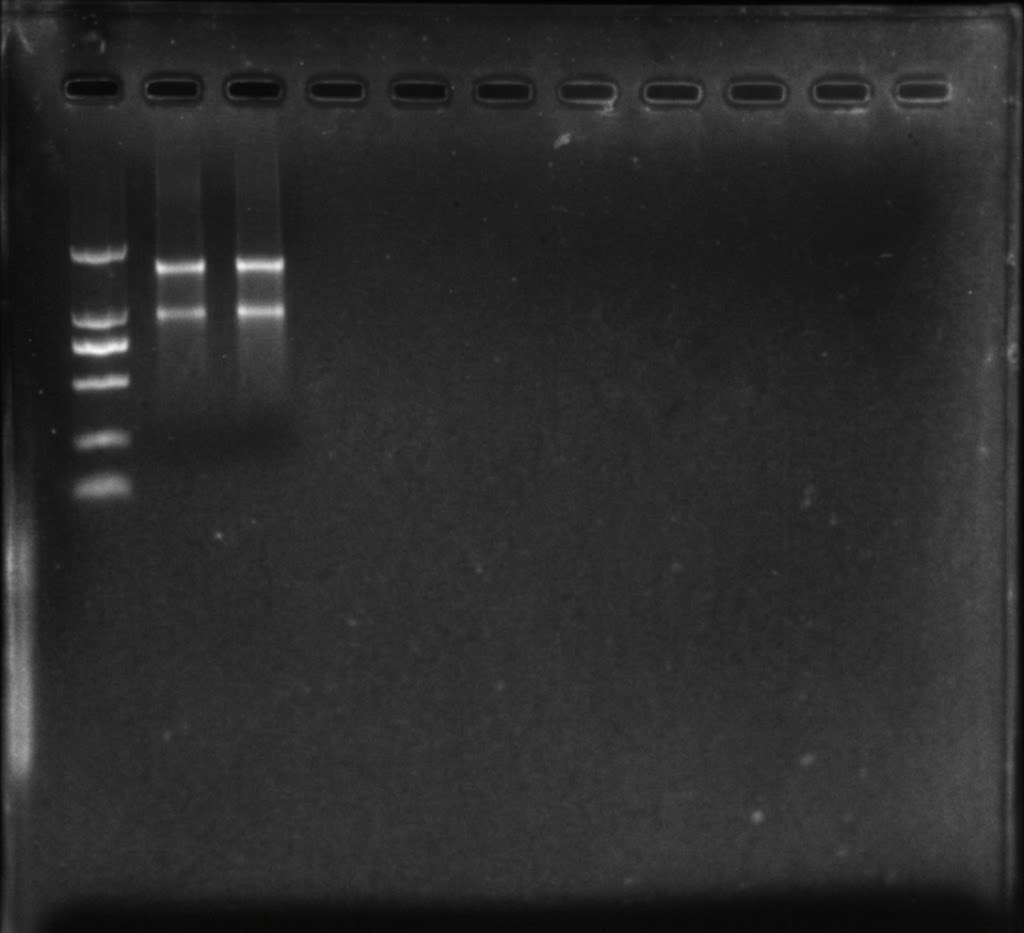
Plant samples deserve a caveat: polysaccharides and polyphenols can co-purify and show up as bright, stuck material in the wells or as lane smearing. Bright wells are frequently misread as “protein or DNA contamination” — often they are polysaccharide–nucleic acid complexes. A dedicated plant protocol (see our RNA extraction kits) handles these matrices better than a generic column protocol.
How to read problem gels
| Pattern | Usual meaning | First response |
|---|---|---|
| Smear from top to bottom of lane | Degradation | Check sample handling; use an RNase-free workflow |
| Clear band above 28S | Genomic DNA carryover | DNase treatment; check lysis conditions |
| Bright well with little lane signal | Polysaccharide/protein complex (common in plants) | Optimize extraction buffer; consider a plant-specific kit |
| No bands at all | Sample loss or very low yield | Re-measure; verify loading and dye integrity |
Running a simple, reliable RNA agarose gel
RNA agarose gels use the same hardware and consumables as DNA gels — agarose, TBE, loading dye, a nucleic-acid stain. The difference is entirely about RNase hygiene:
- Use RNase-free reagents. Freshly prepared or commercial RNase-free TBE (0.5× working concentration), loading dye, and DEPC-treated water. Do not share buffers with a DNA bench.
- Prepare the tank. Wash the tank and combs with detergent, rinse with tap water, then rinse with RNase-free water, and finish with ethanol. This simple sequence removes most RNase residues from shared equipment.
- Load and run. Typical conditions: 1–2% agarose, 0.5× TBE, 100–120 V for 20–30 minutes. Skip heating RNA samples for routine non-denaturing QC — the gel is only being asked to show integrity, not strand length.
- Stain and inspect. Visualize under UV or blue light, photograph promptly, and archive the image with your experiment record.
For samples that will travel or wait before processing, immerse fresh tissue in an RNA stabilization reagent such as RNAfixer at the point of collection — the gel is only as good as the sample that went into the tube.
When a gel is not enough
Microcapillary instruments (for example the Agilent Bioanalyzer) add an objective integrity score — the RNA Integrity Number (RIN) — computed from the electrophoretic trace rather than by eye. RIN has become a reporting standard for RNA-seq and microarray submissions. The score and its interpretation were introduced in Schroeder et al. (BMC Molecular Biology, 2006), and earlier work by Imbeaud et al. (Nucleic Acids Research, 2005) showed how standardized trace classifiers improve RNA quality assessment. For routine lab QC, however, a plain agarose gel remains the fastest, cheapest, and most widely available integrity check.
Bottom line
- OD ratios measure purity proxies, not integrity. A 1.8 ratio does not prove intact RNA.
- Run a gel before trusting concentration or starting downstream experiments.
- Learn the four patterns — good RNA, degradation smear, DNA band, bright well — and most RNA QC problems become obvious in two minutes.
If you are building or troubleshooting an RNA workflow, see our RNA and DNA extraction kits and RNA stabilization products, or request a quotation for your lab’s volumes. All products listed are for Research Use Only (RUO). Not for diagnostic, therapeutic, or clinical use.
References
- Schroeder A, Mueller O, Stocker S, et al. The RIN: an RNA integrity number for assigning integrity values to RNA measurements. BMC Molecular Biology. 2006;7:3. doi:10.1186/1471-2199-7-3
- Imbeaud S, Graudens E, Boulanger V, et al. Towards standardization of RNA quality assessment using user-independent classifiers of microcapillary electrophoresis traces. Nucleic Acids Research. 2005;33(6):e56. doi:10.1093/nar/gni054
More questions
- Can you run RNA on an agarose gel? Yes. A simple agarose gel is the most direct integrity check: intact total RNA shows sharp 28S and 18S rRNA bands, degraded RNA turns into a smear. See the 28S/18S gel guide for how to read the bands.
- Do I still need a gel if I use an automated RNA analyzer? Automated analyzers give a quick integrity estimate, but a conventional agarose gel remains the widely used verification when the result matters — it costs little and shows the actual band pattern.