
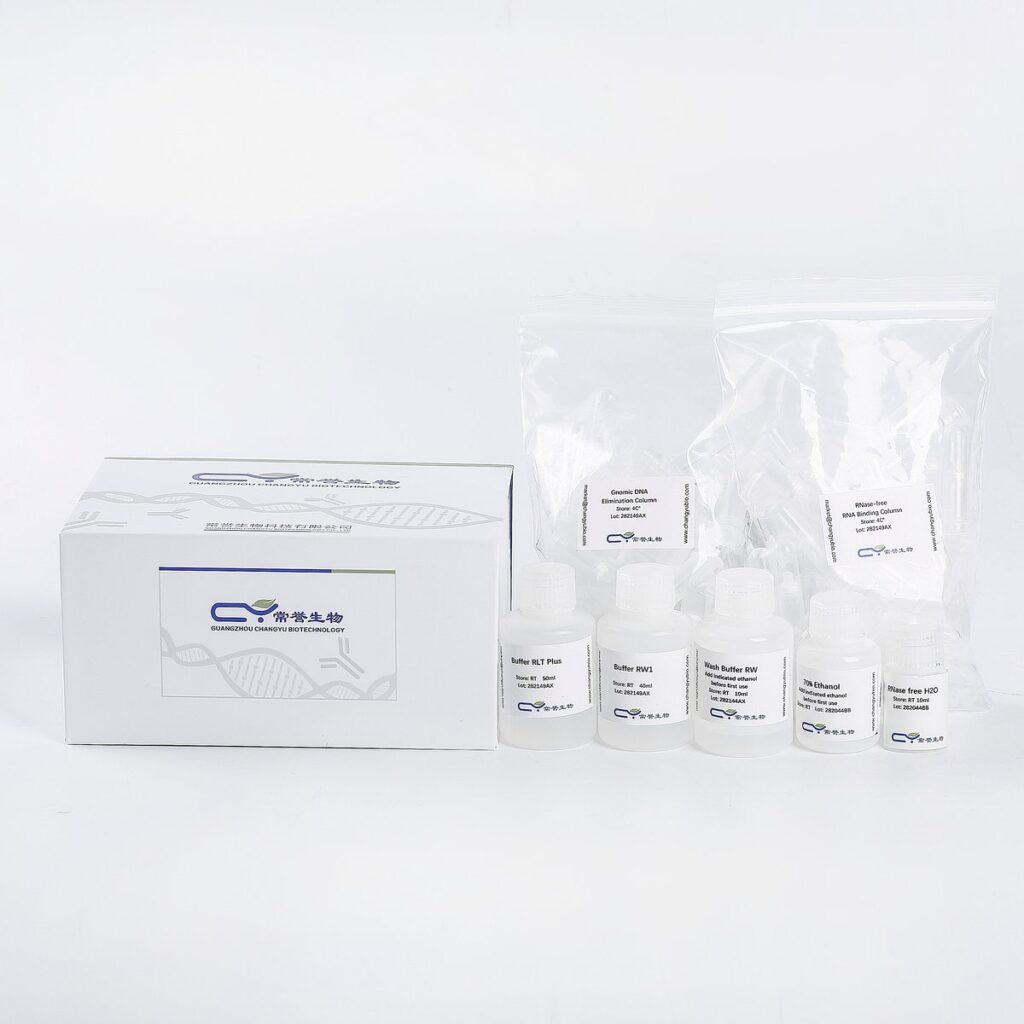
Designed for rapid purification of total RNA from plants — including complex, polysaccharide- and polyphenol-rich species. Genomic DNA Elimination Columns remove gDNA without DNase; the whole process is phenol/chloroform-free.
Key Features
- Handles complex plant samples with high secondary-metabolite content
- gDNA Elimination Columns — no DNase digestion step
- Phenol/chloroform-free workflow
- Lysis buffer immediately inactivates RNase and DNase
Specifications
| Pack size | 50 Preps (CYRN53) |
| Components | Lysis Buffer CLB, Lysis Buffer RLT Plus, Buffer RW1, Wash Buffer RW, RNase-free H2O, gDNA Elimination Columns, RNA Binding Columns |
| Storage | RT (15–25°C); do not refrigerate — low temperature causes precipitation |
| Shipping | Ambient (room temperature); no ice packs |
| Note | Keep container tightly sealed after use |
Typical Applications
- Total RNA from polysaccharide- or polyphenol-rich plants (manual examples: Dendrobium, Salvia, ginseng).
- Typical OD260/280 about 2.0–2.2 without a separate DNase digest.
- Ship and store 15–25°C — do not refrigerate the kit.
Input ranges at a glance
| Sample | 100–200 mg fresh or frozen plant tissue in 1 ml CLB working lysis buffer (with β-mercaptoethanol) |
| Grinding | Direct grinding (no liquid nitrogen) or liquid-nitrogen grinding for difficult, degradable samples |
| Purity | Typical OD260/OD280 2.0–2.2 with no DNA contamination |
| Time | Single extraction completed in about 30 minutes |
| gDNA removal | Built-in genomic DNA elimination column — DNase digestion generally not needed |
| Elution | 30–50 µl RNase-free water; 70–90°C pre-warming raises yield |
| Storage / pack sizes | RT only (15–25°C transport and storage — cold storage causes precipitation); stable 9 months; CYRN53 (50 preps) |
Limits and handling
- For laboratory research use only. Not for diagnostic or therapeutic use.
- Shipped at ambient temperature (no ice packs).
- Shipped and stored at ambient temperature (15–25°C). Do not refrigerate or freeze the buffers — 4°C or −20°C causes precipitation and loss of performance.
- Keep bottles tightly closed. β-mercaptoethanol in Buffer CLB is required as in the manual.
- Add the indicated ethanol to Wash Buffer RW before first use.
Who sets these specifications
Changyu Bio supplies Cat# CYRN53 and is responsible for the specifications on this page. Confirm pack sizes, storage, and protocol against the PDF manual before use. Quotes: market@changyubio.com or WhatsApp +86 18665577773.
Complex Plant RNA FAQ
Which difficult plants has this kit been validated on?
The manual lists complex medicinal herbs — Dendrobium, Salvia, Saussurea and ginseng; starch-rich seeds — rice, wheat and corn; and fruits — grape, blueberry, strawberry and watermelon.
Is DNase digestion needed?
Generally no — the gDNA elimination column removes most genomic DNA, and the manual reports typical OD260/OD280 ratios of 2.0–2.2 with no DNA contamination. For trace-DNA-sensitive assays (e.g., low-abundance TaqMan RT-PCR), use RNase-Free DNase I on-column, or design intron-spanning primers.
Why must this kit stay at room temperature?
Cold storage (4°C or −20°C) causes precipitation that affects reagent performance. Store and transport the kit at 15–25°C and close bottles promptly after use. If CLB precipitates anyway, redissolve at 65°C.
What if my plant tissue is especially difficult?
Raise β-mercaptoethanol to 10–20% final in the CLB working solution if needed, and add PVP40 to 2% final for very complex plants (manual).
Cat# CYRN53 — For research use only (RUO). Not for diagnostic or clinical use. Contact market@changyubio.com or WhatsApp +86 18665577773 for pricing and export delivery to Africa, Southeast Asia and worldwide.